The simplified edition does not use Docker Swarm. It deploys one enterprise application node with a total of 4 virtual machines:
1 enterprise node hosts tier0-enterprise + EMQX.2 database nodes form a PostgreSQL + TimescaleDB primary/standby cluster.1 Witness node participates in database supervision, quorum, and failover.
The simplified edition reduces deployment complexity. The tradeoff is that the application layer and EMQX are single points of failure. Only the database layer keeps DB VIP + Witness high availability.
The following IP addresses are placeholders. Replace them with the real site network before implementation.
| Type |
Name |
Planned IP |
Description |
| Application node |
ent-enterprise-01 |
10.60.10.11 |
Single enterprise node hosting tier0-enterprise + EMQX |
| Logical entry |
DB VIP |
10.60.20.10 |
Unified database endpoint, points only to the current primary |
| Database node |
ent-db-01 |
10.60.20.11 |
PostgreSQL + TimescaleDB primary candidate |
| Database node |
ent-db-02 |
10.60.20.12 |
PostgreSQL + TimescaleDB standby candidate |
| Quorum node |
ent-db-witness-01 |
10.60.20.13 |
repmgr witness / database quorum supervisor |
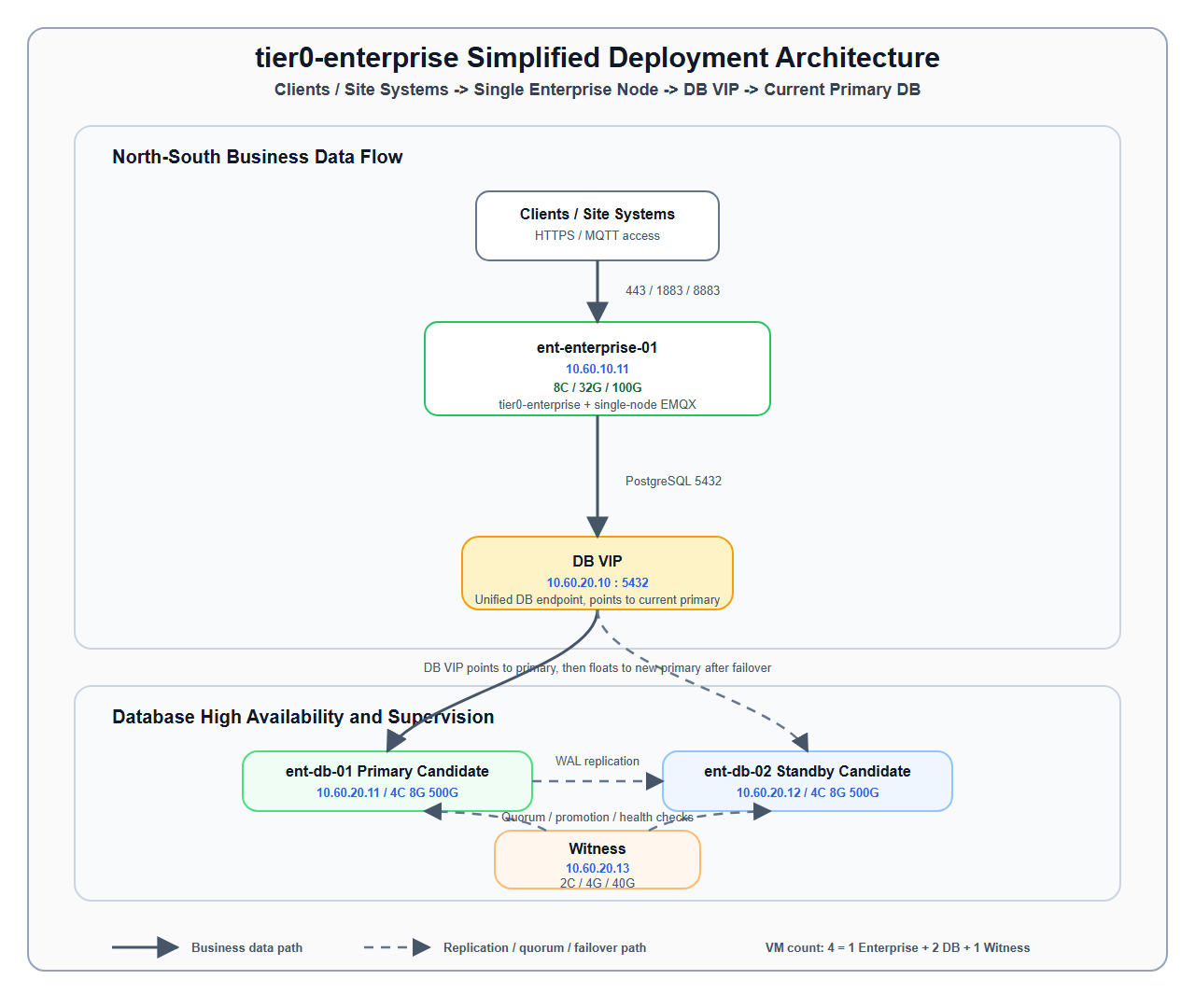
Core paths:
- Business path: clients / site systems ->
ent-enterprise-01 -> DB VIP -> current primary DB.
tier0-enterprise and EMQX both run on ent-enterprise-01.- Database access still goes through
DB VIP; direct application access to ent-db-01/02 is prohibited.
Witness participates only in database quorum, promotion, and health checks. It is not on the business path.
| Phase |
Path |
Description |
| Normal access |
ent-enterprise-01 -> DB VIP -> current primary |
Application always connects to 10.60.20.10:5432 |
| Normal replication |
current primary -> current standby |
PostgreSQL WAL streaming replication |
| Normal supervision |
DB-01/DB-02 -> Witness |
repmgrd reports status; Witness participates in quorum |
| Primary failure |
standby -> Witness |
Standby requests quorum confirmation to avoid split-brain |
| Standby promotion |
standby promote |
Standby is promoted after Witness confirmation |
| VIP floating |
DB VIP -> new primary |
10.60.20.10 binds to the new primary |
| Application recovery |
ent-enterprise-01 -> DB VIP -> new primary |
Application recovers after connection-pool reconnect |
| Node |
Role |
vCPU |
Memory |
Storage |
System disk recommendation |
Data disk recommendation |
Main components |
ent-enterprise-01 |
Single enterprise node |
8 |
32G |
100G |
Single / system disk, 100G |
No separate data disk |
tier0-enterprise, EMQX, optional Nginx/HAProxy |
ent-db-01 |
PostgreSQL/TSDB primary candidate |
4 |
8G |
500G |
/ 80G |
/pgdata 360G, /pgwal 40G, /backup-staging 20G |
PostgreSQL, TimescaleDB, repmgr, keepalived |
ent-db-02 |
PostgreSQL/TSDB standby candidate |
4 |
8G |
500G |
/ 80G |
/pgdata 360G, /pgwal 40G, /backup-staging 20G |
PostgreSQL, TimescaleDB, repmgr, keepalived |
ent-db-witness-01 |
Witness / quorum supervisor |
2 |
4G |
40G |
/ 40G |
Not planned separately |
repmgr witness, monitoring agent, audit logs |
| Category |
Count |
Per-node spec |
vCPU subtotal |
Memory subtotal |
Storage subtotal |
| enterprise application node |
1 |
8C / 32G / 100G |
8C |
32G |
100G |
| PostgreSQL + TimescaleDB nodes |
2 |
4C / 8G / 500G |
8C |
16G |
1000G |
| Witness node |
1 |
2C / 4G / 40G |
2C |
4G |
40G |
| Total |
4 |
- |
18C |
52G |
1140G |
Converted total:
- Total VMs:
4
- Total vCPU:
18
- Total memory:
52G
- Total storage:
1.14T
| Target |
Method |
Port |
Description |
| All VMs |
ssh -i ~/.ssh/chen-rsa ops@<IP> |
22/TCP |
Use after unified key-based SSH is implemented; use site account before that |
ent-enterprise-01 |
https://10.60.10.11 |
443/TCP |
Business entry |
DB VIP |
psql -h 10.60.20.10 -p 5432 |
5432/TCP |
Allow only enterprise node and operations whitelist |
| Source |
Target |
Port |
Purpose |
| Users / site systems |
ent-enterprise-01 |
80/TCP |
HTTP entry or HTTPS redirect, optional |
| Users / site systems |
ent-enterprise-01 |
443/TCP |
HTTPS business entry |
| Devices / site systems |
ent-enterprise-01 |
1883/TCP |
EMQX MQTT plaintext, optional |
| Devices / site systems |
ent-enterprise-01 |
8883/TCP |
EMQX MQTT TLS, recommended |
| Devices / site systems |
ent-enterprise-01 |
8083/TCP |
MQTT WebSocket, optional |
| Devices / site systems |
ent-enterprise-01 |
8084/TCP |
MQTT WebSocket TLS, optional |
| Operations network |
ent-enterprise-01 |
18083/TCP |
EMQX Dashboard, operations whitelist only |
ent-enterprise-01 |
DB VIP |
5432/TCP |
PostgreSQL business access |
| Source |
Target |
Port |
Purpose |
ent-db-01 |
ent-db-02 |
5432/TCP |
PostgreSQL WAL streaming replication |
ent-db-02 |
ent-db-01 |
5432/TCP |
Reverse replication after recovery |
ent-db-01/02 |
ent-db-witness-01 |
5432/TCP |
repmgr metadata / witness communication |
ent-db-01 |
ent-db-02 |
VRRP |
DB VIP floating; allow protocol 112 |
- Do not deploy Docker Swarm.
- Deploy
tier0-enterprise and EMQX on the same ent-enterprise-01 node.
ent-enterprise-01 is an application-layer single point of failure. If it fails, recover manually or rebuild from backup.- The node has only one
100G system disk and is not suitable for long-term business data.
tier0-enterprise business data must be stored in PostgreSQL/TimescaleDB.- Uploads, imports/exports, and reports may be stored locally and backed up. If later upgraded to the standard edition, migrate these files to NFS/NAS or object storage.
- EMQX is a single-node stateful service in the simplified edition.
- Pin its data directory on
ent-enterprise-01, for example /data/emqx.
- Back up configuration, certificates, plugins, and rule-engine configuration.
- No message-layer HA is provided. Use the standard edition with a three-node EMQX cluster if this is unacceptable.
- PostgreSQL:
16 or the site-certified version.
- TimescaleDB: stable version compatible with the selected PostgreSQL major version.
- Replication: physical streaming replication.
- Failover:
repmgrd + witness.
- Database entry:
DB VIP.
- Connection pool: PgBouncer can run on
ent-enterprise-01 to reduce database connection pressure.
- Witness stores only
repmgr witness metadata and supervision logic.
- Witness does not host business SQL.
- Witness failure does not stop the current primary, but reduces trusted automatic failover capability.
| Port / protocol |
Allowed scope |
Purpose |
22/TCP |
Operations network to 4 VMs |
SSH |
80/TCP |
User network to ent-enterprise-01 |
HTTP redirect or internal plaintext entry |
443/TCP |
User network to ent-enterprise-01 |
HTTPS business entry |
1883/TCP |
Devices / site systems to ent-enterprise-01 |
EMQX MQTT plaintext, optional |
8883/TCP |
Devices / site systems to ent-enterprise-01 |
EMQX MQTT TLS, recommended |
8083/TCP |
Devices / site systems to ent-enterprise-01 |
EMQX WebSocket, optional |
8084/TCP |
Devices / site systems to ent-enterprise-01 |
EMQX WebSocket TLS, optional |
18083/TCP |
Operations network to ent-enterprise-01 |
EMQX Dashboard, whitelist only |
5432/TCP |
enterprise to DB VIP; DB/Witness internal |
PostgreSQL / repmgr |
112/VRRP |
Between DB nodes |
DB VIP floating |
9100/TCP |
Monitoring system to 4 VMs |
node exporter, optional |
| Failure scenario |
Expected behavior |
Business impact |
ent-enterprise-01 fails |
Application and EMQX both stop; manual recovery or rebuild from backup is required |
Full application-layer outage |
| Current DB primary fails |
Standby is promoted after Witness quorum; DB VIP floats |
Write interruption for seconds to minutes; application must reconnect |
| DB standby fails |
Primary continues serving, replication alert is raised |
No direct business outage, but DB hot standby is lost |
| Witness fails |
Current primary continues serving, but automatic failover confidence is reduced |
No direct business outage, restore Witness first |
| DB VIP floating fails |
Database may have a new primary, but unified entry is unreachable |
Business outage; manual VIP binding required |
| Check item |
Pass criteria |
| 4 VM hostnames are fixed |
hostnamectl matches the plan |
| Unified SSH works |
Operations terminal can access all 4 VMs with key-based SSH |
| Time synchronization |
Time drift across 4 VMs is below 1s |
| Firewall is open |
Ports from section 9 are allowed by scope |
| enterprise service is healthy |
tier0-enterprise health check passes |
| EMQX state is verified |
EMQX node, listening ports, and persistent directory are healthy |
| enterprise disk usage is safe |
/ usage is below 70%; log and cache cleanup is configured |
| DB primary/standby is healthy |
repmgr cluster show shows primary, standby, and witness healthy |
| DB VIP works |
enterprise node can connect to 10.60.20.10:5432 |
| Primary DB failover drill |
Standby can be promoted and DB VIP can float |
| Backup restore drill |
Backup can be restored to a test database |
- Create 4 VMs and fix hostnames, IPs, time synchronization, and SSH.
- Initialize OS baseline, firewall, mounts, and kernel parameters.
- Deploy
tier0-enterprise on ent-enterprise-01.
- Deploy single-node EMQX on
ent-enterprise-01.
- Deploy PostgreSQL + TimescaleDB primary/standby.
- Deploy repmgr witness, repmgrd, and DB VIP floating scripts.
- Verify connectivity, EMQX recovery, database failover, backup restore, and routine checks.
- Finalize runbooks, credential archives, and routine check tasks.
- The simplified edition has an application-layer single point. If
ent-enterprise-01 fails, the whole business service is unavailable.
- EMQX is single-node and does not provide message-layer HA.
ent-enterprise-01 has only a single 100G system disk. Logs, cache, attachments, and temporary files must be controlled.- If application-layer or EMQX HA is required later, switch to the standard edition.
- Database RPO/RTO is not confirmed. This primary/standby design cannot guarantee zero data loss.
- DB VIP floating scripts must be verified on site, especially whether the virtualization/network platform allows VRRP.